

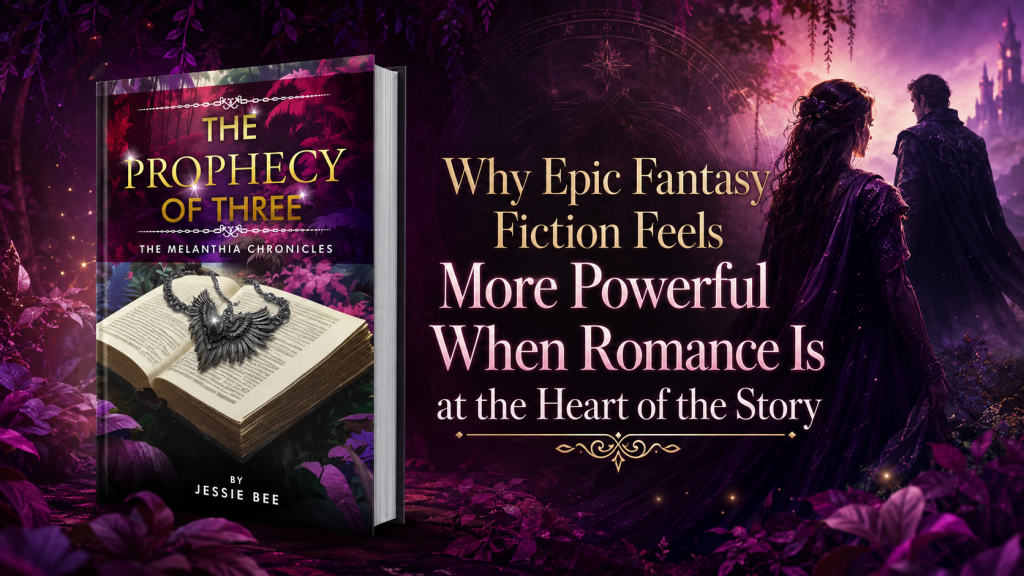
Epic fantasy fiction becomes unforgettable when the stakes are larger than one kingdom, one prophecy, or one magical realm. Readers may come for ancient bloodlines, hidden worlds, dangerous quests, and supernatural warnings, but they stay because the story asks deeply human questions: Who am I? Who can I trust? What am I willing to lose? And what happens when love becomes part of the battle?
That is where Romantic Fantasy gains its emotional power. It does not weaken the adventure or distract from the magic. Instead, it gives the danger a heartbeat. When a heroine is caught between the ordinary life she understands and the impossible destiny calling her forward, romance becomes more than attraction. It becomes a test of loyalty, courage, identity, and choice.
In the strongest Epic Fantasy stories, love is never just a subplot. It is often the force that reveals what a character fears, what they value, and who they are becoming.
What Makes Epic Fantasy Fiction So Addictive
Epic fantasy fiction pulls readers into worlds that feel bigger than the page. These stories often begin with mystery: an old family secret, a strange dream, a forgotten prophecy, a magical bloodline, or a hidden truth that has been waiting for the right person to uncover it.
That sense of discovery is part of what makes the genre so addictive. Readers are not only watching events unfold; they are piecing together a larger puzzle. A forest may not be just a forest. A family name may carry ancient meaning. A warning may sound impossible until the heroine realizes it was never meant to be ignored.
Epic Fantasy works because every choice feels connected to something larger. One decision can change a friendship, a family, a kingdom, or an entire magical realm. The best stories build tension through:
Ancient conflicts that refuse to stay buried.
Magical systems with real consequences.
Prophecies that raise more questions than answers.
Hidden histories that reshape the present.
Characters who must grow before they can lead.
Readers enjoy these stories because they offer both wonder and pressure. The world is beautiful, but it is not safe. The heroine may be brave, but she is not fully prepared. That combination creates momentum. Every chapter feels like another door opening into danger, truth, or transformation.
Why Romantic Fantasy Adds Emotional Depth
Romantic Fantasy gives epic adventure something essential: emotional intimacy. A magical war can be thrilling, but when the heroine has someone she is afraid to lose, the danger becomes personal.
Romance adds tension in ways battle scenes alone cannot. A slow-burn relationship builds through small moments: a glance that lasts too long, a conversation that reveals more than intended, a protective gesture, a disagreement that exposes fear, or a moment of vulnerability neither character expected. These scenes matter because they allow readers to feel the emotional cost of the fantasy world.
Romance also complicates trust. In Epic Fantasy, characters often face secrets, divided loyalties, and impossible choices. The person a heroine is drawn to may know more than he admits. He may belong to another world. He may be tied to the prophecy she is trying to understand. That uncertainty keeps readers emotionally invested.
The romance becomes powerful because it is not easy. It asks questions such as:
Can love survive secrets?
Can trust grow in the middle of danger?
Can two people choose each other when destiny is pulling them apart?
Can vulnerability be a form of courage?
This is why Romantic Fantasy resonates so strongly with readers. It combines the thrill of discovery with the ache of emotional risk. The heroine is not only fighting outside forces. She is also learning what it means to open her heart when everything around her is uncertain.
The Power of a Heroine Caught Between Two Worlds
One of the most compelling patterns in epic fantasy fiction is the heroine who begins in an ordinary world but slowly realizes her life has never been ordinary at all. She may be focused on school, friendships, family routines, or everyday plans. Then something strange interrupts the familiar rhythm: a dream, a vision, a warning, a name from the past, or a feeling she cannot explain.
This type of heroine is powerful because readers recognize her before the magic begins. She has normal concerns. She jokes with friends. She questions herself. She may be stubborn, guarded, loyal, curious, or afraid of change. Then the fantasy world enters her life, and suddenly the ordinary details become clues.
That contrast creates emotional depth. The heroine is not simply stepping into adventure; she is being pulled away from the version of herself she thought she understood. Destiny is not presented as glamorous. It is confusing, disruptive, and sometimes frightening.
This is where self-discovery becomes central to Epic Fantasy. The heroine must learn that courage is not the absence of fear. It is the decision to keep moving when the truth becomes uncomfortable. She must decide who to trust, what to believe, and whether she is willing to accept a role she never asked for.
For U.S. readers who enjoy character-driven fantasy, this emotional realism matters. A magical world feels more believable when the heroine reacts like a real person. She doubts. She resists. She makes mistakes. She leans on friends. She questions love. She wants answers before she is ready for the consequences.
That is what makes her journey meaningful.
When Love and Prophecy Collide
A prophecy can create suspense, but romance makes that suspense hurt.
When love and prophecy collide, the story becomes more than a question of what will happen next. It becomes a question of what the characters are willing to sacrifice. A supernatural warning may reveal that the heroine has a role to play, but romance forces her to ask how that role will affect the people closest to her.
This conflict is especially effective in Romantic Fantasy because love creates competing loyalties. The heroine may want to protect someone, but the prophecy may require honesty. She may want a normal relationship, but the magical world may make normal impossible. She may feel drawn to someone connected to her destiny, even while fearing that connection could put them both in danger.
Romance also raises the emotional stakes of secrecy. In Epic Fantasy, secrets often protect people until they begin to harm them. A hidden identity, a forgotten family line, or a warning from another realm can change the meaning of every relationship. When the heroine discovers the truth, she must decide whether love is something that can survive revelation.
The strongest stories do not make love simple. They use it to reveal character. A person’s response to danger, jealousy, loyalty, and fear often says more than any battle. When romance is written well, it becomes a mirror. It shows the heroine who she is, what she wants, and what she is still afraid to admit.
Why Epic Fantasy Still Needs Human Relationships
Even the most magical Epic Fantasy needs human relationships to feel real. Readers may love enchanted forests, ancient portals, powerful bloodlines, and supernatural enemies, but emotional connection is what gives those elements lasting impact.
Friendships bring humor, honesty, and grounding. Family bonds create history and emotional pressure. First love adds vulnerability. Rivalry adds friction. Betrayal adds consequence. Without these relationships, even the most detailed fantasy world can feel distant.
Human relationships also give readers a reason to care about the outcome. Saving a realm matters more when the heroine’s friends could be hurt. A prophecy matters more when it threatens the life she knows. A magical truth matters more when it changes how she sees her parents, her past, or the person she is falling for.
This is why romance belongs at the heart of many Epic Fantasy stories. Love reminds readers that destiny is not abstract. It affects real hearts. It changes conversations, friendships, choices, and futures.
For authors writing in this space, the lesson is clear: world building should never replace emotional truth. A fantasy realm may be vast, but the reader’s connection often begins in a quiet moment between characters. A confession. A warning. A kiss interrupted by fear. A friend who notices something is wrong. A heroine who realizes that the life she knew is slipping away, and she must become someone stronger to protect it.
That is where Epic Fantasy becomes more than spectacle. It becomes personal.
Conclusion
The best epic fantasy fiction stays with readers because it blends wonder with emotional transformation. Magical realms, ancient prophecies, hidden histories, and dangerous quests create the adventure, but romance gives that adventure its heart.
Romantic Fantasy works because love raises the stakes. It makes courage more intimate, danger more painful, and destiny more complicated. When a heroine is caught between two worlds, the most powerful question is not only whether she can survive the prophecy. It is whether she can discover who she truly is while protecting the people she loves.
That combination of danger, romance, identity, and wonder is what makes Epic Fantasy feel timeless. It lets readers escape into another world while still feeling something deeply human.
Style reference reviewed from the uploaded Jessie Bee manuscript sample, including its heroine-led fantasy-romance tone, contemporary voice, prophecy elements, friendship dynamics, and emotional self-discovery arc.